


Mixed Media Projects
The Skin Machine
2018: Installation - Bacterial cellulose 'skins', plaster cast, Arduino powered robot arm
The Skin Machine installation featured bio-art processes and technology to question the
notion of ‘normal’ and ‘functional’ social identities, specifically related to mental illness. The
work explores the idea that in order to protect the self from social dismissal one must create
a second, stronger skin. The Skin Machine itself is kinetic and involves the culturing of
cellulose skin over a plaster cast to create a multi-layered bio-textile. On a technical level, it
was an exploration into the collaboration with microbes to produce artistic substrates.

Words will never hurt me, but...
2017: Installation: Bacterial cellulose 'skins', laser engraved clinical data on X-Ray lightboxes
This bio-artwork featured laser engraved bacterial cellulose “skins” featuring a breakdown of
my personal medical records relating to mental illness. This work explored the impact of
seeing a diagnosis in written form, the loss of my ‘healthy’ identity (i.e showing up as
mentally ill in physician records moving forward), and the feeling that these words might as
well have been directly etched onto my flesh.


Pure Immanence
2016, Installation: Bacterial cellulose 'skin' hospital screens, projection mapping, video manipulation via MatLab
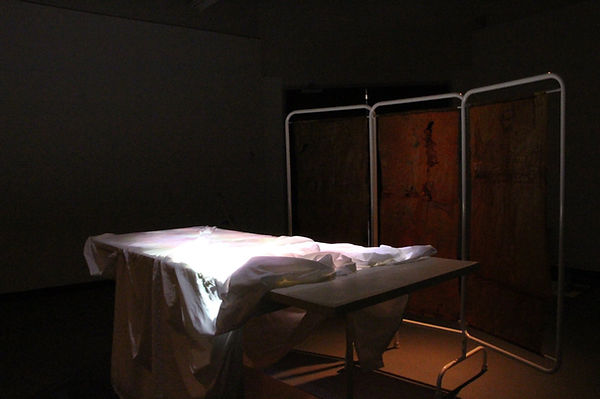

This installation involved the culturing of bacterial cellulose ‘skins’ as a visual metaphor for the ‘sick’ or ‘monstrous’ body. The cellulose itself is non-pathogenic bio-polymer, and very safe to culture. Medical research has been conducted on the potential of the particular
strain of bacteria, Acetobacter xylinum, as a platform for skin grafts, tissue engineering and wound dressing (Huang et al., 2014).
Pure Immanence discusses heterotopic space (Michel Foucault’s notion of between spaces) as it pertains to the ritualised behaviour of self-harm using these skin screens as a stand in for the body.
The projection mapping featured a video of a scar on my chest that was run through a code developed by health scientists at MIT to show where blood pools at the surface of the skin (1).
1: Hao-Yu Wu, Michael Rubinstein, Eugene Shih, John Guttag, Frédo Durand, and William Freeman. 2012. Eulerian video magnification for revealing subtle changes in the world. ACM Trans. Graph. 31, 4, Article 65 (July 2012), 8 pages. https://doi.org/10.1145/2185520.2185561

Korper/Leib

2015: Installation: Large format photography, forged steel armour, photo transfer 'skins'
The series entitled Korper/Leib represents an exploration of public and private identities. As a woman who struggles with self-mutilation, the artist creates multiple, complicated layers to protect her mind and body from ostracization in a capricious Western society. In The Absent Body, Drew Leder discusses the notion of the Körper and the Leib in relation to Freudian concepts. The Körper refers to the physical body, or that which is presented in the physical world. The Leib, in contrast, is the lived body, or that which experiences the world. Korper/Leib is ideal for this body work because it explores the varying ways in which identities are formed by the body: both the one presented outwardly and the one that shapes subjective experience.
In discussing this work, the artist first identifies the use of armour as an icon and conduit for issues of identity, strength, and vulnerability. She then establishes the basis for her stance on social identities—understood as the Körper—and represents these as two entities inherent in the photographic portion of the installation: the identities of woman-as-social-participant and the “sick body.” Finally, she addresses the physical armour objects and accompanying photo transfers as visual representations of the Leib, embodying both the subjective/vulnerable self and the “absent” identity.


Anomaly

2015: Body of Work:
Slipcast ceramic heads, mixed media sculpted brains, large format photography, cast plaster pills, constructed acrylic pill-box, plaster cast hand and arm in glass bell jar
The series of experimental works entitled Anomaly represent an exploration into the objective gaze of the medical paradigm against patients with mental illness, specifically those suffering from compulsive self-harm tendencies. The body of work consists of elements that, while different in media and execution, conceptually touch on pharmacology as a quick-fix treatment method, the purposeful objectivity in medical photography and the use of diagnostic models to explain wholly subjective and idiosyncratic experiences.


Written in Red
2014: Body of Work: Acrylic/Oil Paintings, forged steel helmets, cast Featherlite figures, cast plaster figures, Lee Enfield, Gewehr 98 replicas and soundscape
As a mixed media body of work, Written in Red reminds viewers of the importance of remembering the stories from the Second World War as a reminder of the potential for hatred within humanity. Oral and written histories about the human experience of war form a significant conceptual foundation of this project.
The projects within this body are rooted in research and in collecting memories and stories of the “everyday” soldier. Matthias Winzen encapsulates this idea by stating that collecting is “a defensive act intended to lessen the fear of the future and to confront what is unpredictable” (Winzen, 55). Similarly, Theodor Adorno postulated that “the will to possess reflects time as a fear of loss” (56). The collection includes stories derived not necessarily of the “victor,” but of the so-called “enemy,” the collective soldier, and the collective victims of the atrocities of war. This is not limited to working with the Allies—“to the victor go the spoils”—but has also delved into the brainwashing psychology of the Nazis. Friedrich Nietzsche has served as a particularly valuable resource for this line of inquiry, as reflected in the armour works.


